
The Problem: Current Streaming Limitations Hold Users Back
To be honest, Fire TV gadgets have never felt fast. Users always complained about how slow apps would open, how old the software was, and how hard it was to find their favourite shows, even though the Fire OS ran on Android.
What causes the most pain? Fire OS was old-fashioned. Your phone runs the most recent version of Android, but Fire TVs were stuck on software that was built on older versions of Android. This made it annoying for users to not get what they thought they would get.
What Exactly Is Vega OS?
Now things start to get interesting. It’s not just another form of Android; Vega OS is Amazon’s big break from Google’s world. The Linux kernel and the React Native framework were used to build this operating system from the ground up. The bold move by Amazon is to take over every part of your watching experience.
It’s like how Amazon responds to Apple’s way of doing things. Apple controls every part of an iPhone, from the hardware to the apps. Amazon now wants to do the same thing with Fire TVs. Vega has been in the works by the company in secret since 2019. Echo devices that ran the Linux 5.16 kernel showed the first signs of it.
What makes Vega different? It’s designed specifically for streaming devices, not repurposed from smartphone operating systems. This means every line of code serves one purpose: delivering content to your TV as efficiently as possible
Key Features That Actually Matter
Lightning-Fast Performance on Limited Hardware
The Fire TV Stick 4K Select proves Vega’s efficiency credentials. Despite packing just 1GB of RAM and a MediaTek MT8698 processor with ARM Cortex-A55 cores running at 1.7GHz, this device delivers what Amazon calls “remarkably fast” app launches.
Compare that to the Fire TV Stick 4K Max’s 2GB of RAM, and you’ll understand why Amazon is so confident about Vega’s streamlined architecture. The new OS eliminates the Android overhead that previously slowed down these budget devices

React Native Developer Framework
Amazon chose React Native as Vega’s primary development platform. This JavaScript-based framework means developers can write apps once and deploy them across multiple Amazon devices. For users, this translates to more consistent app experiences and faster updates.
The Vega SDK supports React Native version 0.72 components and APIs, giving developers familiar tools while ensuring apps run smoothly on Amazon’s custom hardware
Cloud App Program: The Smart Transition Strategy
Here’s Amazon’s clever solution to the chicken-and-egg problem that kills most new operating systems. Instead of waiting for developers to port every app to Vega, Amazon created the Cloud App Program.
This system streams Android versions of popular apps from Amazon’s cloud servers until developers create native Vega versions. You won’t notice the difference – Netflix, Disney+, and other major services work exactly as expected. Amazon even covers the streaming costs for nine months to encourage developer adoption
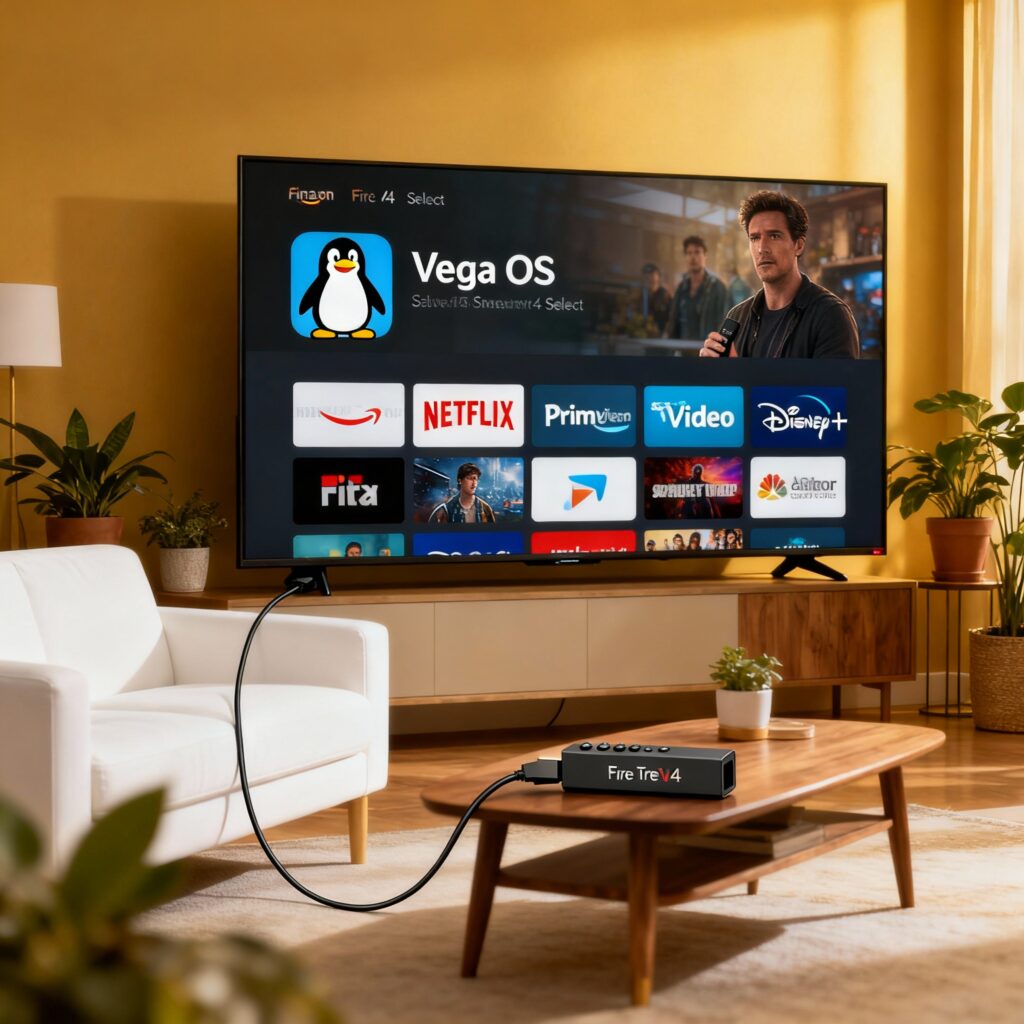
The Fire TV Stick 4K Select is the first Vega gear.
When it comes out on October 15, 2025, the Fire TV Stick 4K Select will cost $39.99, making it Amazon’s cheapest 4K streaming gadget. This is what you get:
Details about the technology
CPU: MediaTek MT8698 MCM with 4 ARM Cortex-A55 cores that can reach up to 1.7GHz
1GB of LPDDR4 RAM for memory
Storage: 8GB of built-in storage
Graphics Card: G310v2 up to 500MHz
Bluetooth 5.0 and Wi-Fi 5 (802.11ac) 2×2 MIMO let you connect.
4K Ultra HD and HDR10+ video formats are supported.
Dolby Digital Plus 7.1 surround sound for sound
What’s Not There? Compared to Models with More Features
In order to stay at $39.99, the Select model has to give up some things. You only get HDR10+ and Wi-Fi 5 instead of Wi-Fi 6. It also doesn’t support Dolby Vision. Only 1 GB of RAM, which is half of what the Fire TV Stick 4K Max has.
But these restrictions won’t bother most people who want to watch basic 4K content on popular services like Prime Video, Netflix, Disney+, and YouTube.
What’s Going on with Sideloading: A Big Change
The big problem is that Vega OS doesn’t allow any sideloading at all. Vega only lets apps from Amazon’s App Store be installed, unlike older Fire TVs that let tech-savvy users add their own apps.
This means that you can’t run Kodi, other launchers, or streaming apps that aren’t officially approved by Amazon. For a lot of Fire TV fans, this is a big step backward in terms of gadget freedom.
Amazon has a simple reason: they want better security, stability, and customer experience. They can make sure that every app works properly and doesn’t hurt device speed or security by controlling the whole app ecosystem.
How this will affect you in real life if you’re an average streamer
Vega OS is likely to make your experience better if you mostly use Netflix, Prime Video, Disney+, Hulu, and other popular services. You should be able to open apps faster, the interface will feel more responsive, and you won’t have to wait for Android compatibility levels to get updates.
For Heavy Users and People Who Cut the Cord
Many advanced users can’t buy it because they can’t sideload. Millions of people use popular apps like Kodi to play local media, but they won’t work on Vega devices unless Amazon says they can.
This makes power users look for options, such as the Nvidia Shield Pro or Google TV, which still work with Android.
For Developers
Amazon is actively courting developers with comprehensive tools and financial incentives. The company provides Visual Studio Code extensions, CLI tools, and thorough documentation for porting existing React Native apps to Vega.
The Cloud App Program offers a safety net – your existing Android app can run on Vega through cloud streaming while you develop a native version

Gaming Integration and Future Features
Vega OS promises robust gaming support through Xbox Gaming and Amazon Luna cloud gaming services. While these features aren’t available at launch, Amazon plans to roll them out soon.
The lightweight architecture should handle cloud gaming better than previous Fire TV devices, especially with the dedicated gaming optimizations Amazon has built into Vega
Alexa+ Integration: The Evolution of AI Assistants
Voice commands aren’t the only thing that the new Alexa+ system can do. Users can ask for shows that are like the ones they just watched, films that are good for the whole family, or specific stars. The AI makes personalised suggestions across a number of streaming sites.
Alexa+ gives sports fans live scores, player stats, and the ability to find games on services like DIRECTV, Sling TV, and Prime Video. Soon, you will be able to look for specific scenes in thousands of Prime Video movies.
Questions People Ask Often
Will the Vega OS be added to my present Fire TV?
Not at all. Amazon said that Vega OS will only be put on brand-new devices. Fire TVs that are already out there will keep getting updates for Fire OS, but they won’t switch to Vega.
I have a Vega OS tablet. Can I still sideload apps?
Not at all. Vega OS doesn’t let you sideload anything; it only lets you install apps from Amazon’s official App Store.
Where is the support for Dolby Vision?
Only HDR10+ works with the Fire TV Stick 4K Select. It doesn’t support Dolby Vision. In the future, Dolby Vision may be added to more high-end Fire TVs with Vega OS.
How does the Cloud App Program work?
Amazon can stream the Android version of an app from their cloud services if it doesn’t come with Vega OS. From the store, you can tell it’s a “Amazon cloud-hosted app” by the note.
Is Fire OS slower than Vega OS?
The Vega’s streamlined, Linux-based design, according to Amazon, makes it much faster. Even though it only has 1GB of RAM, the Fire TV Stick 4K Select shows this by having fast app starts.
Amazon’s long-term plan: a look at the bigger picture
This change is more than just an update to the software. Amazon can add more advertising, subscription services, and commerce to the watching experience because it controls the whole software stack.
In the future, Vega devices will likely have better shopping features, smarter content suggestions based on Amazon’s huge data sets, and better interaction with Amazon’s wider range of services.
This change also makes Amazon able to compete more directly with Apple TV, Roku, and Google TV by giving customers a more unified experience than these other companies can provide.
Vega OS marks the beginning of Amazon’s complete independence from Google’s Android ecosystem. While the sideloading restrictions disappoint power users, mainstream consumers will likely appreciate the improved performance and streamlined experience. The Fire TV Stick 4K Select provides an affordable entry point to this new ecosystem, but whether Vega OS succeeds depends on Amazon’s ability to maintain app compatibility and deliver on its performance promises.


