
What if you could control your phone, laptop, or AR glasses… without even touching them?
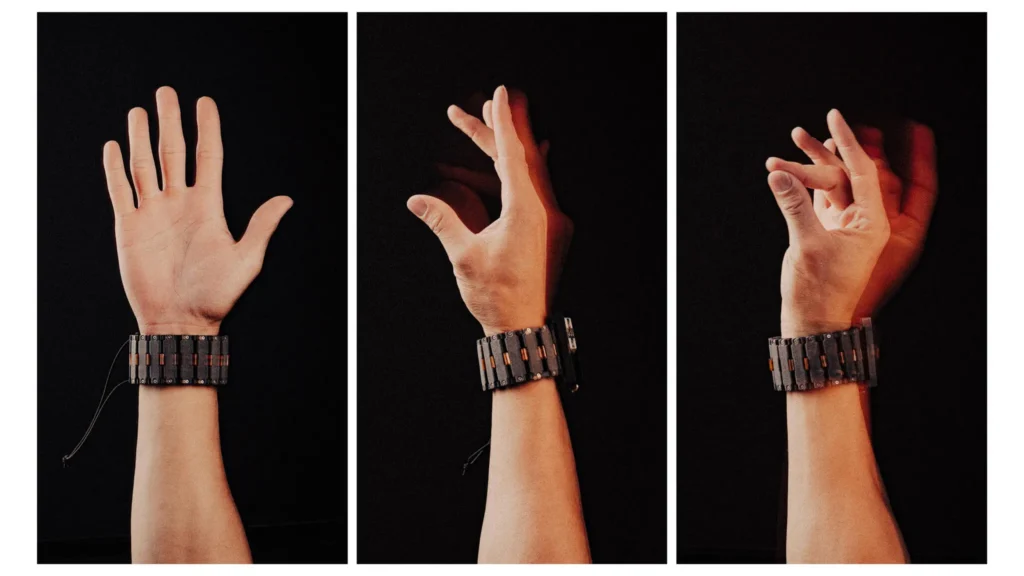
Enter Meta’s mind-blowing innovation: a wristband that reads your muscle signals to perform digital tasks. No keyboard. No touchscreen. Just your intent and a flick of your fingers.
This is more than just a gadget—it’s a glimpse into a future where technology listens to your body, and where interaction feels like second nature.
🧬 What Is Meta’s Gesture-Control Wristband?
Meta’s Reality Labs has developed a wearable device that looks like a fitness band but performs like something straight out of Iron Man. It uses surface electromyography (sEMG) to detect the tiny electrical signals your brain sends to your wrist and fingers.
The result? You can:
- Scroll menus by pinching your fingers
- Type mid-air or on a table
- Write messages silently on your leg or desk
- Control apps, devices, and even AR interfaces—all while your hand rests comfortably at your side
The wristband doesn’t just guess; it understands what you want to do, using highly trained AI models powered by a massive neural network.
💡 How Does It Work?
When you intend to move your fingers, even without completing the motion, your brain sends signals to your hand muscles. The wristband’s non-invasive sensors pick up these signals and use machine learning to translate them into precise digital commands.
It’s powered by:
- Advanced sEMG sensors
- AI trained on 300+ people and 100+ hours of muscle data
- Deep learning models that don’t require calibration
Imagine typing out a WhatsApp message just by moving your fingers subtly on your lap, while your phone stays in your pocket. That’s the kind of experience Meta aims to deliver.
🖋️ Write Without Writing: Handwriting Recognition Reimagined
One of the wristband’s most futuristic features is handwriting recognition. You can scribble invisible words on a desk, table, or even your own leg—and the system deciphers your intended letters and words.
Perfect for:
- Private messaging in public
- Taking quick notes in meetings
- Communicating quietly in crowded spaces
- Accessibility for those unable to speak or use touchscreens
Meta reports that with minor personalization, handwriting recognition becomes up to 16% more accurate, adapting to each user’s unique muscle patterns over time.
🤖 The End of the Keyboard?
Let’s face it—keyboards, mice, and touchscreens were never meant for humans on the go. They’re great in static setups, but clunky when you’re walking, standing, or multitasking.
Meta’s wristband is built to:
- Replace traditional input tools
- Free your hands from physical devices
- Let you interact on the move
- Enhance AR/VR environments where touch input isn’t ideal
Meta even tested the prototype with its Project Orion AR glasses, showing seamless interaction between gesture input and digital overlays—without the user having to look down or touch a screen.
♿ Empowering People with Disabilities
This tech isn’t just exciting—it’s life-changing.
Meta is working with Carnegie Mellon University to test the wristband on individuals with spinal cord injuries or complete hand paralysis. Even those who can’t physically move still generate trace muscle signals, and the wristband can potentially decode them to control digital interfaces.
For people with disabilities, this means:
- Reclaiming independence
- Communicating more freely
- Controlling smart homes, computers, or assistive devices—with nothing but intent
📊 Backed by Science and Shared with the World
Meta’s work has been published in the renowned journal Nature, marking this as a serious scientific milestone—not just a flashy tech reveal.
They’ve also:
- Released a massive public dataset of sEMG recordings
- Shared design principles for building muscle-based input systems
- Made their earlier datasets for pose estimation and surface typing open-source
Why? To accelerate research and collaboration. Meta isn’t just building a device—they’re helping shape the future of wearable human-computer interaction.
🎯 Real-Life Applications That Will Blow Your Mind
Here’s how you might use this wearable in the real world:
✅ Text without touching your phone while on the subway
✅ Control your AR workspace while walking down the street
✅ Send silent replies in meetings
✅ Type or draw mid-air while in VR
✅ Help someone with a disability gain digital independence
✅ Trigger smart home commands with a simple wrist gesture
This isn’t a niche device—it’s a versatile, scalable solution for mainstream computing, accessibility, and immersive tech.
🛡️ Is It Safe? What About Privacy?
Meta emphasizes that:
- All training data comes from consenting participants
- The system functions without storing or profiling your private signals
- Personalization is optional and only improves accuracy
Still, the rise of biometric devices raises valid concerns. As this tech progresses, ethical design, data security, and user trust will be critical pillars.
🔮 The Future Is in Your Hands (Literally)
Meta’s wristband is more than a new gadget. It’s a paradigm shift—a bold reimagining of how humans and machines will interact in the coming decade.
From everyday users to gamers, AR explorers, and people with disabilities, this device promises to make computing more intuitive, inclusive, and invisible.
We’re not just looking at the next input tool. We’re looking at the next digital revolution, where you won’t need a keyboard, mouse, or even a screen to stay connected.
📢 Final Thoughts: The Wristband That Thinks With You
If Meta delivers what it promises, this wristband will reshape how we live, work, play—and communicate.
👉 Ready to ditch the keyboard?
👉 Want to type by tapping your fingers in mid-air?
👉 Curious about gesture-powered AR?
Then stay tuned, because the future is wearable—and it’s already here.