


Health in Space exploration pushes the boundaries of human endurance, especially when it comes to maintaining astronaut health. The unique weightless environment aboard the International Space Station (ISS) presents challenges such as muscle atrophy, bone density loss, cardiovascular changes, and immune system alterations. To keep astronauts safe and mission-ready, space agencies like NASA and international partners employ cutting-edge technologies and rigorous research methods to monitor and protect health in real-time. This article dives deep into how experts monitor astronauts’ health and the groundbreaking tech used on the ISS.
The Microgravity Challenge: Why Space Affects Our Bodies ⚖️
In microgravity, the body undergoes significant physiological changes because muscles and bones don’t bear their usual weight. Without gravity pulling down, astronauts face:
- Muscle atrophy: Loss of muscle mass and strength.
- Bone density reduction: Risk of osteoporosis-like symptoms.
- Cardiovascular adaptation: Changes in blood flow and heart function.
- Immune system alterations: Decreased efficiency fighting infections.
To counteract these effects, astronauts spend around two hours daily doing specially designed exercises aimed at preserving muscle and bone health in space.
Advanced Exercise Equipment: The ISS Gym 🏋️♂️
Astronauts use specialized devices optimized for microgravity, including:
- Advanced Resistive Exercise Device (ARED): Simulates weightlifting on Earth using vacuum cylinders providing up to 272 kg of resistance. Essential for maintaining muscle strength and bone density through squats, deadlifts, and heel lifts.
- Treadmill with Vibration Isolation and Stabilization (TVIS): Allows aerobic workouts while minimizing vibrations that could affect the station’s structure.
- Cycle Ergometer with Vibration Isolation and Stabilization (CEVIS): A stationary bike equipped for space that reduces mechanical noise and vibration.
These machines enable astronauts to exercise effectively, preserving their physical health despite the absence of gravity.
Real-Time Health Monitoring with Wearable Technology ⌚
Health data collection in space has evolved dramatically with wearable biosensors integrated into astronauts’ daily lives, notably:
- Bio-Monitor by the Canadian Space Agency: A smart shirt and headband system that continuously tracks vital signs like heart rate, respiration, blood pressure, skin temperature, and oxygen saturation. The unobtrusive design allows data collection during sleep, exercise, and daily routines. Data is transmitted to ground control for continuous analysis by medical experts.
- Garmin Smartwatches and BioButton Sensors: Monitor heart rate, oxygen saturation, temperature, respiratory rate, and stress markers. This wearable ecosystem supports cardiovascular health monitoring and stress assessment in real-time.
- Smart Contact Lenses: Embedded with sensors to measure intraocular pressure, critical for preventing vision problems caused by fluid shifts in microgravity (Spaceflight-Associated Neuro-Ocular Syndrome).
These devices enable doctors on Earth to oversee astronaut health continuously and intervene proactively if any abnormalities are detected.
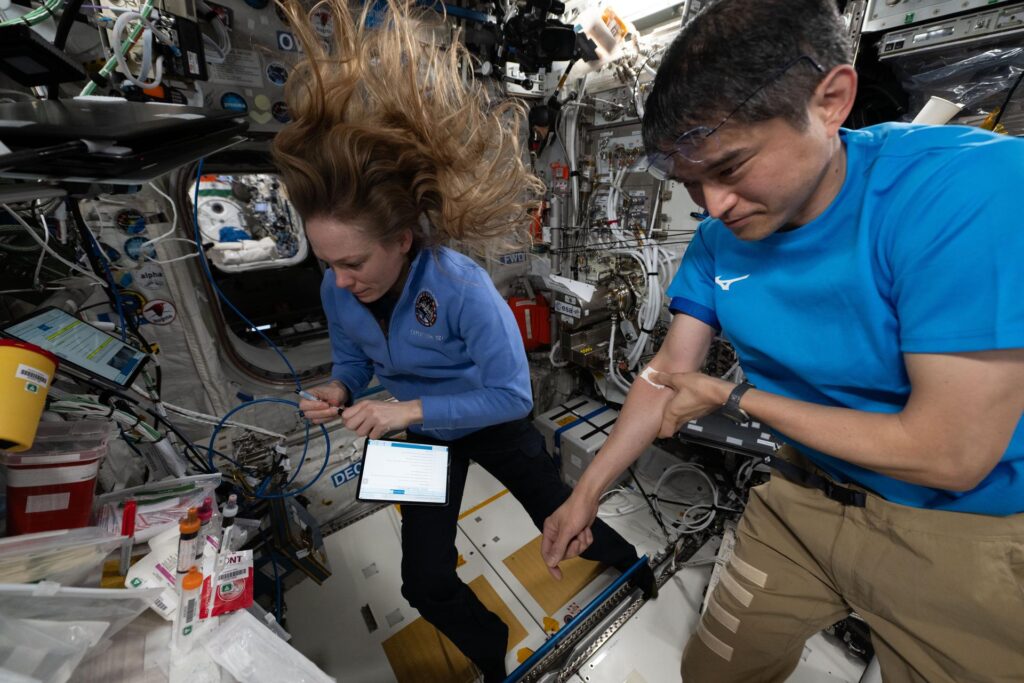
Cutting-Edge Medical Diagnostics and Research 🩺
Beyond exercise and wearables, astronauts perform a variety of medical diagnostics aboard the ISS:
- Ultrasound Scans: Astronauts conduct heart and vein ultrasound examinations routinely. These scans help detect cardiovascular changes like artery stiffness or fluid redistribution that could pose risks post-mission. Real-time transmission allows Earth-based specialists to analyze data and provide guidance immediately.
- Blood and Immune System Tests: Regular blood draws help monitor immune function and check for stress-related changes. Understanding immune response alterations due to spaceflight is crucial for developing countermeasures.
- Electrical Muscle Stimulation (EMS): Researchers are testing EMS to stimulate muscle contractions via electrical impulses. EMS supplements exercise routines by improving muscle function, potentially cutting exercise time and reducing equipment weight.
Daily Maintenance and Life Support Systems 🔧
Health monitoring also involves maintaining the ISS life support systems, ensuring critical components like water purification and oxygen generation work flawlessly. Astronauts perform regular checks and repairs to keep these systems operational, which is vital for their well-being and the success of missions.

Pros and Cons of Current Astronaut Health Monitoring Methods
| Pros | Cons |
|---|---|
| Continuous real-time monitoring ensures early detection of health issues. | Devices may face reliability challenges under space conditions. |
| Advanced exercise equipment effectively counters muscle and bone loss. | Limited space and equipment weight constraints on the ISS. |
| Wearables provide non-invasive, comprehensive physiological data. | Data privacy and security concerns during transmission to Earth. |
| Medical tests support deep understanding of space-induced physiological changes. | Some diagnostic procedures require astronaut training and time. |
| Research benefits healthcare advancements on Earth (aging, mobility disorders). | Microgravity effects not fully understood for very long missions. |
The Future of Space Health Research: Towards Moon, Mars, and Beyond 🌕
As missions extend beyond low Earth orbit with plans to explore the Moon and Mars, protecting astronaut health becomes even more critical. Future directions include:
- More sophisticated wearable sensors with enhanced AI and machine learning for predictive health diagnostics.
- Lightweight, multifunctional exercise devices tailored to deep-space habitats.
- Improved understanding of radiation effects combined with microgravity.
- Development of personalized countermeasures to maintain long-term muscle, bone, cardiovascular, and immune health.
These advancements promise to not only support astronaut longevity and mission success but also translate into better health technologies benefiting people on Earth.
Conclusion
Monitoring astronaut Health in Space aboard the ISS involves a seamless blend of rigorous exercise, wearable biosensors, advanced medical diagnostics, and ongoing research. This comprehensive approach helps counteract the harmful effects of microgravity, ensuring astronauts stay healthy during missions and return safely to Earth. The innovations developed for space health monitoring are expanding the horizons of medical science, offering potential breakthroughs for healthcare worldwide as humanity ventures further into space.
By embracing cutting-edge technology and constant research, space agencies worldwide continue protecting the explorers of tomorrow—making the dream of deep-space missions a safer reality today.
If this article is published on https://tipsrocket.in with strategic keywords such as “astronaut health monitoring,” “space exercise equipment,” “wearable technology in space,” and “ISS health research,” it can attract organic traffic interested in space, technology, and health science.


