


iPhone Air vs Galaxy S25 Edge 5G: Why Samsung May Have the Better Slim Phone
The slim phone race has officially kicked off, with Apple and Samsung taking thinness to a whole new level. Apple has introduced its iPhone Air, measuring just 5.6mm thick, making it one of the slimmest iPhones ever. Samsung, however, is countering with its own slim yet powerful flagship, the Samsung Galaxy S25 Edge 5G, which comes in at 5.8mm thickness but does not skimp on flagship essentials.
In this comparison, we’ll explore whether Apple’s quest for thinness has come at too high a cost, and why Samsung’s slightly thicker Galaxy S25 Edge might actually be the more practical choice for buyers in 2025.
Design and Build: Slim vs Slightly Smarter
- iPhone Air: At 5.6mm, the iPhone Air proudly claims the crown as Apple’s thinnest flagship yet. It features a titanium frame and IP68 water and dust resistance, giving it both elegance and durability. However, going this thin has reportedly forced Apple to make compromises elsewhere.
- Galaxy S25 Edge: At 5.8mm, Samsung’s Galaxy S25 Edge is barely thicker but actually weighs 2 grams less than the iPhone Air. It also comes with a titanium frame and IP68 rating, ensuring durability without losing practicality.
While Apple wins the numbers game when it comes to millimeters, Samsung seems to have struck a better balance between thinness and usability. Sometimes, being ultra-thin is not always ultra-practical.
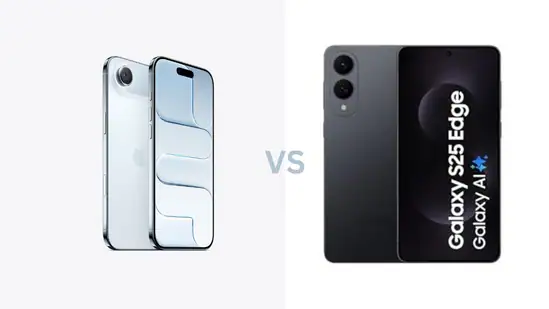
Display: Samsung’s AMOLED Advantage
Both phones sport 120Hz OLED displays, but the way they handle visuals is quite different.
- iPhone Air: Apple emphasizes brightness, claiming better outdoor readability — perfect for those relying on their phone under direct sunlight.
- Galaxy S25 Edge: Samsung offers a QHD+ AMOLED display, which not only looks crisper but is also better for high-resolution gaming, video editing, or VR applications.
If you’ve ever watched 4K HDR Netflix content or streamed a football match, you’ll know the difference — Samsung’s QHD+ AMOLED simply delivers more immersive visuals compared to Apple’s flat OLED panel.
Cameras: More Lenses, More Possibilities
Photography is one of the areas where Apple’s iPhone Air has clearly sacrificed features in the name of thinness.
- iPhone Air: Comes with a single 48MP Fusion camera on the back. While Apple’s computational photography is excellent, the lack of an ultrawide sensor makes the Air less versatile. At a starting price of ₹1.20 Lakh, a single rear lens feels underwhelming.
- Galaxy S25 Edge: Packs a 200MP primary sensor alongside a 12MP ultrawide camera, giving users more shooting flexibility. Whether you want to capture wide landscapes, high-detail portraits, or crop into ultra-high-resolution shots, Samsung clearly gives more value.
For instance, imagine you’re traveling in Paris. With the iPhone Air, you can take a crisp photo of the Eiffel Tower in the background. But with the Edge’s ultrawide, you can capture both the Eiffel Tower and the scenic Trocadéro gardens around it in a single frame. That’s where versatility wins.

Performance and Software: Snapdragon AI Power vs Apple Efficiency
- iPhone Air: Powered by the latest A19 Pro chip and paired with 12GB RAM, Apple’s efficiency ensures smooth gameplay, photo editing, and multitasking. iOS remains fast and secure — no surprises here.
- Galaxy S25 Edge: Runs on the Snapdragon 8 Elite with 12GB RAM. More importantly, Snapdragon has been aggressively optimized for on-device AI, making the S25 Edge a powerhouse for AI-driven tasks like live translation, AI photo edits, and advanced multitasking under OneUI 8.
While Apple has announced “Apple Intelligence,” it still feels like Samsung is ahead in practical AI use-cases — from enhanced voice assistants to predictive task management. For a 2025 consumer, AI isn’t just a buzzword, it’s a day-to-day productivity booster.
Battery and Charging: Bigger vs Smarter
Battery life is another area where Samsung’s Galaxy S25 Edge has a technical advantage.
- iPhone Air: Features a relatively small 3,149mAh battery, but thanks to Apple’s efficient silicon, it claims up to 27 hours of video playback. Supports 20W wired charging.
- Galaxy S25 Edge: Comes with a 3,900mAh battery, offering a longer-lasting safety net for power users. With 25W wired charging, it tops up faster as well.
Real-world difference: If you’re binge-watching YouTube or gaming on 5G, Samsung’s bigger battery ensures fewer mid-day charges. Apple seems more focused on design thinness than lasting endurance.
Price and Value for Money
Both smartphones fall in the ₹1–1.2 Lakh flagship segment, but the value you get feels different.
- iPhone Air: Offers prestige, style, and ultra-thin design but drops key features such as an ultrawide camera and extra battery capacity.
- Galaxy S25 Edge: Manages to stay nearly as thin while still packing dual cameras, a bigger battery, faster charging, and a more advanced display.
For buyers spending over ₹1 Lakh in India, practicality often outweighs bragging rights — and Samsung seems to offer just that.
Pros and Cons
iPhone Air
✅ Thinnest iPhone ever (5.6mm)
✅ Titanium body and IP68 rating
✅ Bright OLED display
❌ Single rear camera only
❌ Smaller battery
❌ Less focus on AI
Samsung Galaxy S25 Edge 5G
✅ Dual cameras with 200MP flagship sensor
✅ Larger 3,900mAh battery
✅ QHD+ AMOLED with 120Hz
✅ Snapdragon 8 Elite + AI features
❌ Slightly thicker at 5.8mm
❌ Marginally slower outdoor brightness

| Feature | iPhone Air | Samsung Galaxy S25 Edge 5G |
|---|---|---|
| Thickness | 5.6mm | 5.8mm |
| Weight | Slightly heavier (2g more) | Lighter by 2 grams |
| Build Material | Titanium frame | Titanium frame |
| Water & Dust Resistance | IP68 | IP68 |
| Display Type | OLED | QHD+ AMOLED |
| Refresh Rate | 120Hz | 120Hz |
| Brightness (Outdoor) | Higher | Slightly lower |
| Rear Camera | Single 48MP Fusion camera | Dual: 200MP main + 12MP ultrawide |
| Front Camera | Standard front camera | Advanced front camera |
| Processor | A19 Pro chip | Snapdragon 8 Elite |
| RAM | 12GB | 12GB |
| AI Capabilities | Apple Intelligence (basic) | Advanced AI with OneUI 8 |
| Battery Capacity | 3,149mAh | 3,900mAh |
| Video Playback Time | Up to 27 hours | Slightly less than 27 hours |
| Charging Speed | 20W wired charging | 25W wired charging |
| Price Range (India) | Around ₹1.20 Lakh | Around ₹1.20 Lakh |
Conclusion: The Practical Winner is Samsung
The iPhone Air is beautiful, thin, and futuristic — but it feels like Apple compromised too much for thinness. With only one rear camera and a smaller battery, it risks being more of a “showpiece” than a daily driver.
On the other hand, the Samsung Galaxy S25 Edge 5G shows how slim phones can still be practical, offering a versatile camera setup, advanced AI, longer battery life, and faster charging — all without sacrificing design.
If slimness is your priority, the iPhone Air wins the crown. But if day-to-day usability and flagship practicality are what you care about, the Samsung Galaxy S25 Edge is the better deal in 2025.
FAQs
Q1. Is the iPhone Air thinner than Samsung Galaxy S25 Edge?
Yes, the iPhone Air is slightly thinner at 5.6mm compared to the Galaxy S25 Edge’s 5.8mm.
Q2. Which has a better camera: iPhone Air or Galaxy S25 Edge?
The Galaxy S25 Edge offers a 200MP main sensor and a 12MP ultrawide, while the iPhone Air only has a single 48MP rear camera. Samsung provides more versatility.
Q3. Which slim phone has better battery life?
Thanks to its larger 3,900mAh battery, the Galaxy S25 Edge performs better under heavy usage, although iPhone Air claims up to 27 hours of video playback due to Apple’s optimization.
Q4. Is the iPhone Air worth ₹1.2 Lakh in India?
It depends on your priorities. If you want the slimmest phone with premium design, yes. But for practical features like dual cameras, bigger battery, and advanced AMOLED display, the Galaxy S25 Edge offers better value in the same price range.
Q5. Which slim phone handles AI better?
The Galaxy S25 Edge runs on Snapdragon 8 Elite with enhanced AI features in OneUI 8, making it better for AI-powered tasks than Apple’s newer but still limited Apple Intelligence.


