
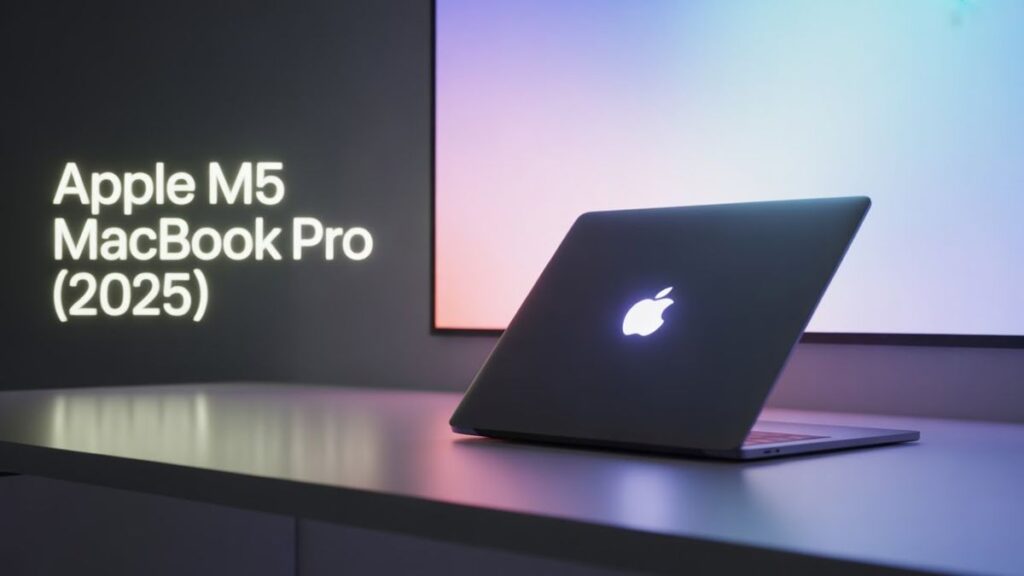

Apple just made it hard for every laptop maker to do their best. There are big changes in what you can do with AI on the new 14-inch MacBook Pro with M5 chip. It doesn’t just make things slightly faster. This machine turns cloud-based workflows into lightning-fast local operations. Its AI processing is up to 3.5 times faster than M4 and six times faster than M1.
Pre-orders began on October 15, and the device will go on sale in India on October 22 for Rs 1,69,900, which is about $1,599 USD. At Rs 1,59,900, it’s an even better deal for students. The M5 MacBook Pro markets itself as the best laptop for everyday AI tasks, whether you’re transcribing lectures, running diffusion models, or compiling code with local LLMs.
Why does M5 change the game?
Apple used third-generation 3-nanometer technology to make the M5. This technology packs more transistors into a smaller space to make the chip work better and faster. But what really makes Apple’s products special is how they rethought the relationship between AI and graphics processing.
GPU of the Next Generation with Neural Accelerators
Apple’s biggest architectural risk yet is the main feature: a Neural Accelerator is built right into each of the 10 GPU cores. It’s not just a small change to the specs; this is a major overhaul of how chips handle AI tasks.
As a result? The M4 doesn’t have nearly four times the peak GPU compute performance for AI. The 16-core Neural Engine and the Neural Accelerators work together to give you lightning-fast speed when you’re doing text-to-image generation in Draw Things or processing large language models in LM Studio. Developers can directly access this power through Apple’s Foundation Models framework. This means that the next generation of design and productivity tools will be built to work with this architecture.
The GPU also improves graphics with third-generation ray tracing, which makes overall graphics performance up to 45 percent better than M4. This means faster graphics rendering and smoother frame rates for gamers and 3D artists by up to 30%.
Performance Improvements for the CPU
It really is “the world’s fastest performance core,” as Apple says. Four performance cores and six efficiency cores make up the M5’s 10-core CPU, which makes multithreaded performance up to 15% faster than the M4.
In multicore tasks, real-world benchmarks show that the M5 does better than even the older M3 Pro. For developers, this means that Xcode will compile 1.2 times faster than M4. Exports in Final Cut Pro are now faster than ever for video editors. The MacBook Pro can run Adobe Photoshop and Final Cut Pro side by side without any problems, which is great for people who need to run a lot of demanding apps at the same time.
Key Features That Matter
Performance metrics only matter if they solve real problems you face every day. Here’s where the M5 MacBook Pro truly shines.
AI Workflow Acceleration
The M5 MacBook Pro transforms how you interact with AI tools. College students can transcribe lecture notes using on-device models that run up to 6 times faster than M1. Creators storyboarding projects with AI tools experience 3.5 times faster processing than M4.
Business professionals running local models in webAI to analyze data get insights without cloud latency or privacy concerns. Developers working with LM Studio can load and run LLMs locally at unprecedented speeds. The 153GB/s unified memory bandwidth—a nearly 30 percent increase over M4 and more than double M1—means larger AI models fit entirely on device
The updated 16-core Neural Engine speeds up Apple Intelligence features like Image Playground, which makes generative AI tools much faster. With Live Translation in macOS Tahoe, Messages are translated automatically, FaceTime captions are translated in real time, and spoken translation is available in the Phone app. All of this is done locally.
Graphics and Gameplay Speed
Besides AI, the M5 MacBook Pro has a lot of graphics power. It’s amazing that Blender can render 1.7 times faster than M4 and 6.8 times faster than M1. These time savings add up to hours back every week for 3D artists and architects who use visualization software that is hard to use.
Better ray tracing and dynamic caching are good for gamers. Frame rates are up to 3.2 times faster than on M1 MacBooks, so AAA games can finally be played at high settings. With the third-generation ray-tracing engine and improved shader cores, lighting, shadows, and reflections look more real than ever on a laptop this size.

Battery Life and How to Store It
Apple says that the battery will last up to 24 hours, which is 14 hours longer than Intel-based MacBooks and four hours longer than M1 models. It works the same whether you’re plugged in or running on battery, which is more important. No slowing down or giving in.
The storage also gets a huge boost. The SSD in the M5 MacBook Pro works twice as fast as it did in the previous generation. The most storage that Apple has added has been raised from 2TB to 4TB. With unified memory options of 16GB, 24GB, or 32GB, you can set up a computer that can handle big projects without the need for external drives.
Pros and cons
Pros:
The M5 MacBook Pro is great at AI processing on-device, so users who care about privacy don’t have to rely on the cloud. The graphics performance is much better than in previous generations, so you can do serious 3D work and games on it. The 24-hour battery life lets you work without having to look for an outlet all day. With faster SSD speeds and more storage options, the machine will be ready for years to come. The fact that it starts at Rs. 1,69,900 with 16GB RAM makes it a better deal than the M4 launch configuration.
Not so good:
The changes don’t feel revolutionary to people who use the M3 or M4. No M5 Pro or M5 Max versions have been released yet for power users who need even more performance. Others had hoped for a visual refresh, but the outside design hasn’t changed. Users who are just trying to get basic work done won’t notice big differences between this model and newer ones.
Real-World Use Cases
Students: Run AI transcription tools to convert lecture recordings into searchable notes instantly. Process research papers through local LLM analysis without uploading sensitive academic work to cloud servers. The 24-hour battery life means attending back-to-back classes without carrying a charger.
Creators: Generate concept art using Draw Things app with diffusion models running entirely on device. Edit 4K video in Final Cut Pro while simultaneously running Photoshop for thumbnail design. Export ProRes files faster thanks to enhanced media engines.
Developers: Run large language models locally using LM Studio or webAI for code completion and debugging. Compile Xcode projects 1.2 times faster than M4, shaving minutes off each build cycle. Test AI-powered features using Apple’s Foundation Models framework without external API costs.
Professionals: Analyze datasets with AI models that respect data privacy regulations by staying on device. Present work on the stunning Liquid Retina XDR display with up to 1,600 nits peak HDR brightness. Join video calls with the 12MP Center Stage camera that automatically frames you perfectly.

Questions People Ask Often
Should you get the M5 instead of the M4?
Not likely for most M4 users. If you do a lot of local LLMs or intensive 3D rendering, the 20% faster CPU and better AI performance will really matter. Wait for the M5 Pro or M5 Max if you’re happy with how the M4 works.
Should people who use M1 get M5?
There is a big jump: the CPU is now twice as fast, the graphics are 2.5 times better, and AI processing is now 6 times faster. If your M1 can still handle your work well, you don’t need to upgrade right away. But the M5 makes huge differences if you’re reaching your performance limits or need serious AI features.
When will the M5 Pro and M5 Max come out?
They haven’t been announced by Apple yet. The M5 Pro and M5 Max should come out in early 2026, based on past trends.
What kinds of configurations are there?
For Rs 1,69,900, the base model comes with 16GB of unified memory and 512GB of storage space. You can get up to 4TB of storage and 24GB or 32GB of RAM. There is a lower entry price of Rs 1,59,900 for education.
How is M5 different from laptops that run Windows?
The M5 has on-device AI processing and a battery life of 24 hours, which is longer than most Windows competitors. Windows laptops still rely a lot on AI in the cloud, and their battery lives rarely last longer than 12 hours in real life.
Conclusion
The M5 MacBook Pro isn’t just another iterative update—it’s Apple’s definitive statement that the future of computing is on-device, private, and powered by AI. The integration of Neural Accelerators into each GPU core fundamentally changes what you can accomplish without cloud dependency.
Who should buy this machine? Students investing in a laptop for the next four years get phenomenal value and future-proofing. Creators who run AI tools, edit video, or work with 3D graphics will notice immediate productivity gains. Developers building AI-powered applications benefit from Apple’s Foundation Models framework and lightning-fast local processing. Professionals who handle sensitive data appreciate keeping everything on device.
M1 users considering an upgrade will experience a dramatic transformation in performance. M3 and M4 users should probably wait for M5 Pro or M5 Max unless AI workflows are central to their work. Intel MacBook users still holding on? The M5 represents an 86 times improvement in AI performance—this is your moment to upgrade.


